If you followed tech news even a little last month, you surely noticed all the talk about how Nvidia’s longtime boss, Jensen Huang, was caught in an extramarital affair with an alleged Chinese spy, and later with one of his colleagues as well, which led to his resignation and departure from the company, as well as a complete collapse of Nvidia’s market value. To understand why all of this was so dramatic and how trillions of dollars get wiped off the stock market, we have to go back to the very beginnings of this company, which has always been close to the hearts of us gamers, though I suspect many don’t know all the details.
Who is Jensen Huang?
Born in Taiwan in 1963, Huang was sent by his parents at the age of nine to live with relatives in Kentucky and attend school there. Despite a very challenging period for Asians in America, and the fact that he didn’t speak the language well, Huang finished school early and graduated in electrical engineering from Oregon State University, working night shifts at a local Denny’s restaurant for a while. Interestingly, his first job was designing chips for AMD, the company that decades later would become one of his main competitors.
While working at AMD, he also completed a master’s degree at prestigious Stanford University, again in electrical engineering. However, in 1993 Huang and two colleagues decided to leave the corporate world and found a new startup that would make chips for computer graphics: Nvidia. Jensen became the company’s first CEO, a position he would hold for 33 years, becoming its public face.
A humble beginning
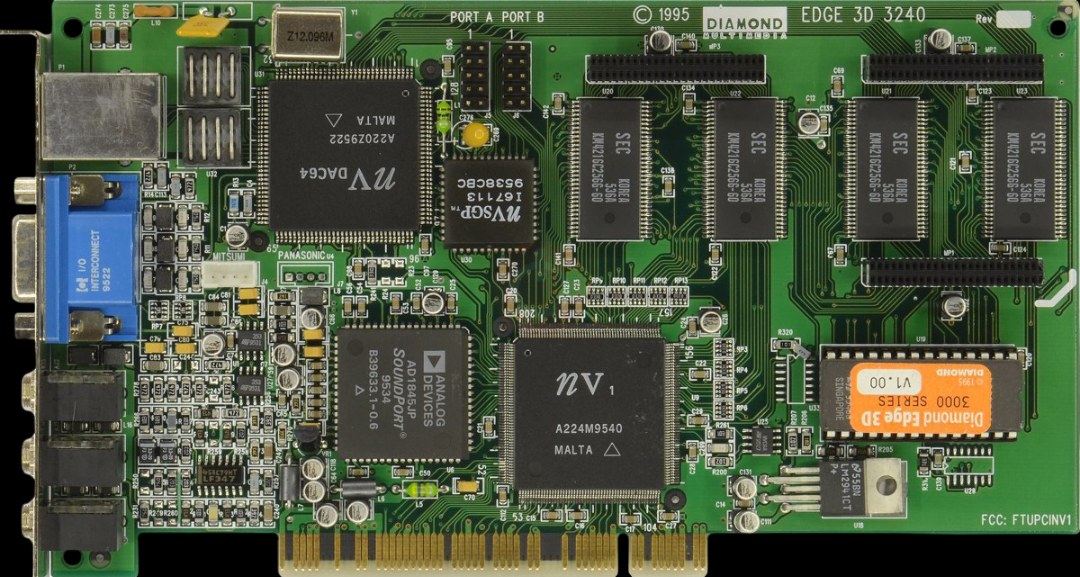
Jensen was already known as a good engineer in those circles, and through his existing contacts he managed to secure investment for his company. Nvidia then began developing its first chip, the NV1, which was designed to create three-dimensional images based on curved quadrilateral surfaces. When it arrived in 1995, it was genuinely good: the older among us will remember that it powered the Diamond Edge 3D graphics card, one of the first that could somewhat compete with the then-dominant 3dfx and their Voodoo graphics accelerators. Those same veterans will also remember names like Matrox Mystique, S3 ViRGE and ATI 3D Rage, all pioneers of 3D graphics on the PC.
The success of the NV1 chip allowed the company to continue developing the NV2. However, just a year after the NV1 launched, the world of 3D gaming changed completely: Microsoft released Direct3D as the standard for Windows, the most popular operating system on the planet. Direct3D had one huge difference compared to Nvidia’s solution: everything was based on triangles, and the NV1 couldn’t handle that!
Nvidia had already struck a deal with Sega for a chip for its new console, the Sega Dreamcast, but it quickly became clear that the NV2 was a product doomed to fail before it even reached the market. Huang hurried to Sega’s headquarters to meet with executive Shoichiro Irimajiri and asked him for a favor: to convert the remaining five million dollars left on the Dreamcast contract into an investment in Nvidia so the company could keep going. Sega accepted the offer, and Nvidia now had just six months of cash to develop a new product on entirely new technology. Meanwhile, Sega would release the Dreamcast with the PowerVR2 chip, and it would sadly be the console that was simply “eaten alive” by the PlayStation 2 and later the Xbox. After that, Sega left the console market for good.
In the meantime, Nvidia developed a new chip, and in 1997 it released the Nvidia Riva 128, which sold more than a million units in four months. The Riva TNT and Riva TNT2 followed, and in 1999 Nvidia launched the GeForce 256, which Huang himself would call “the world’s first GPU”.
What are a CPU and a GPU, and how do they differ?
CPU stands for Central Processing Unit, and it is, so to speak, the “heart” of a computer. It uses a smaller number of very powerful cores that handle tasks one at a time, which suits workloads involving lots of decision-making and dependencies. In the early PC era, all computer graphics work was done by that same processor. The Graphics Processing Unit, or GPU, on the other hand, relies on a huge number of much, in layman’s terms, dumber processor cores. However, these cores can simultaneously perform thousands of small tasks that don’t require much decision-making, which is exactly what you need when drawing thousands or millions of triangles or pixels on screen.
We can illustrate it like this: the CPU is like a first-class chef who makes one dish at a time with exceptional attention to detail and superb flavors. The GPU, on the other hand, employs hundreds of trainee cooks who will never be able to create a masterpiece, but can chop a ton of onions and potatoes in a very short time. Give them a simple task and they will produce a mountain of results very quickly.
CUDA
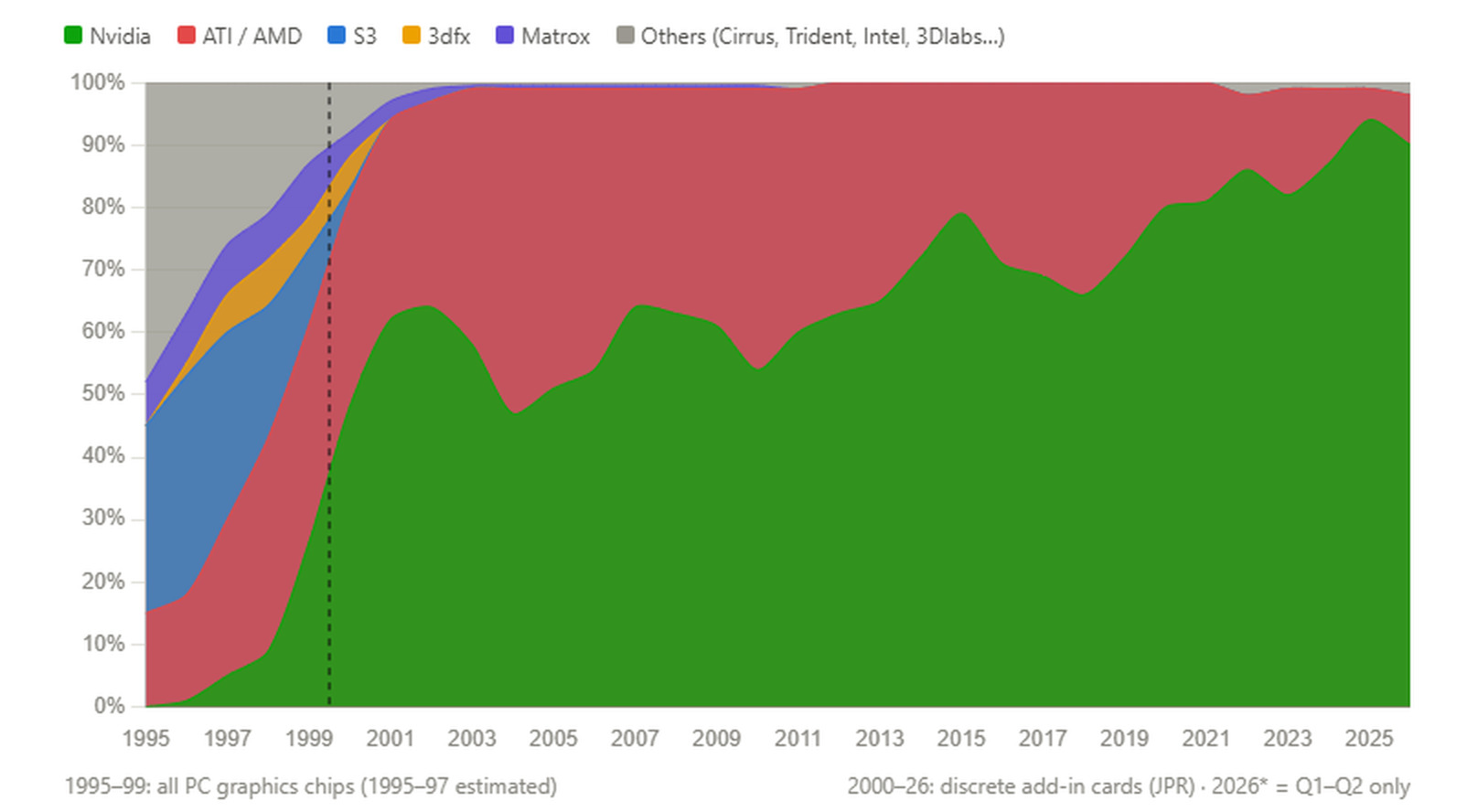
After the initial “gold rush” in graphics cards, by the early 2000s only two manufacturers stood out on the market: Nvidia and ATI (later acquired by AMD). Market share charts clearly show how these two companies traded blows depending on who released the better, cheaper, hotter or noisier graphics card in a given year.
Jensen was aware that they were making incredible amounts of money for the time, but he still wanted to do something more. He began thinking about how his small, “dumb” chips could perform thousands of operations for something that perhaps wasn’t graphics as such, but involved a similar way of calculating and solving problems. He couldn’t come up with such a use himself, but he hit on a brilliant idea: let’s create a software environment that will use our chips as general-purpose parallel processors and offer it to everyone as open source, and maybe some clever scientist will come up with a simulation or something similar. That is how CUDA (Compute Unified Device Architecture) was born, and Jensen himself insisted that the architecture must also be implemented in graphics cards meant for ordinary gamers.
The GeForce 8800 launched in 2006 as the first model with these capabilities. A significant step forward came in 2010, when Adobe decided to include CUDA functionality in its video editing software, Premiere Pro, so for the first time professionals could really benefit and work much faster even on “gaming” graphics cards. What happened next, however, nobody could have predicted, including Huang himself. Those scientists who would supposedly do something with his parallel processors really did show up!

For several years, the ImageNet competition had been held, to which universities sent their best artificial intelligence researchers with the most powerful supercomputers. The goal of the competition was for AI to correctly recognize given images, and one team stood out in an unexpected way. In 2012, a team made up of two University of Toronto students, Alex Krizhevsky and Ilya Sutskever, led by Professor Geoffrey Hinton (who would receive the Nobel Prize in 2024 for his research in artificial intelligence), completed the competition with an image recognition error rate of just 15.3%, while the next best team had an error rate of 26.2%! Which supercomputer did they use? Two Nvidia GeForce GTX 580 graphics cards that you could buy in any store!
The golden age of artificial intelligence
At that point, of course, everyone started paying attention to Nvidia and to the further development of artificial intelligence, which became one of the company’s key focuses. In 2016, Nvidia launched the first supercomputer designed exclusively for AI development, and Jensen personally donated a DGX-1 to the OpenAI project, which six years later would change the world with the launch of ChatGPT. Interestingly, OpenAI was a non-profit organization at the time, and the man posting photos from the event was none other than Elon Musk, who was heavily involved in OpenAI back then.
On the one hand, Jensen invested in developing specific Nvidia chips that were no longer “graphics cards that can also do AI” but were designed directly for that purpose, but his real focus was elsewhere: the idea was to get all the major AI companies, even if he had to give them hardware for free, to start using CUDA as the interface for communicating with the chips. He succeeded. Soon, giants such as Microsoft, Google, Apple and Amazon were running on Nvidia infrastructure, and we shouldn’t forget pioneers like OpenAI or Anthropic, which have a startup culture and the ability to adapt to AI development much faster than the by-now enormous tech corporations.
From today’s perspective, Jensen’s plan is clear: anyone, or at least significantly more companies, can make a GPU, but if his interface is exactly what the most important AI companies need, that puts him in a unique position. As someone nicely put it: “the artificial intelligence gold rush has begun and everyone hopes to get rich on gold, while Nvidia figured out it would get rich selling shovels”.

A dizzying rise and fall in share prices
Since 2023 and the mass adoption of ChatGPT, Nvidia’s share price began to soar, and by the middle of that year the company’s total value exceeded one trillion dollars (a 1 followed by 12 zeros). Just two months before this article was written, Nvidia’s value reached a staggering 5.72 trillion dollars, making it at that moment the most valuable company in the world ever, far ahead of even the previously untouchable Apple. However, as is usually the case, the more valuable you are, the more everyone wants to knock you off the throne, and here politics gets involved as well.
In April 2025, the US administration banned the sale of Nvidia’s best chips to China on national security grounds: it didn’t want China to have the best chips, fearing they would use them to develop AI better than America’s. Jensen publicly opposed this on several occasions; Nvidia produced somewhat weaker chips, those were banned too, but eventually a chip was agreed upon that could officially be exported to China. Unofficially, many Nvidia chips still reach China on the black market.
Only then do we arrive at the whole situation that has been unfolding since late October 2026: The New York Times published a story claiming that US intelligence services had information that Jensen Huang was having an extramarital affair with a certain Alice Huang (no relation), a businesswoman reasonably suspected of being a Chinese spy! Jensen apologized to the company, the board, his family and everyone else, and it seemed the matter would be resolved through some kind of investigation. However, just a few days later a story emerged about an alleged extramarital affair with Nvidia vice president Kimberly Powell, a complete scandal in corporate America. Huang resigned, the shares fell to almost half of their value from a couple of months earlier, and the company’s future was uncertain. And just as we had established all this and finished writing the article, news arrived that Huang, after two weeks in exile, is returning to lead Nvidia after all!
What next?
At this point no one knows, of course, nor whether the man who was so responsible for some of the greatest technological advances of the last 30 or so years is actually some kind of sex maniac, whether he simply got in over his head in political squabbles he wasn’t equipped to handle, or whether someone set him up in order to take full control of such a revolutionary technology. Does Jensen Huang’s return to the helm of the company now mean things will go back to the way they were? I don’t think anyone knows at this point.
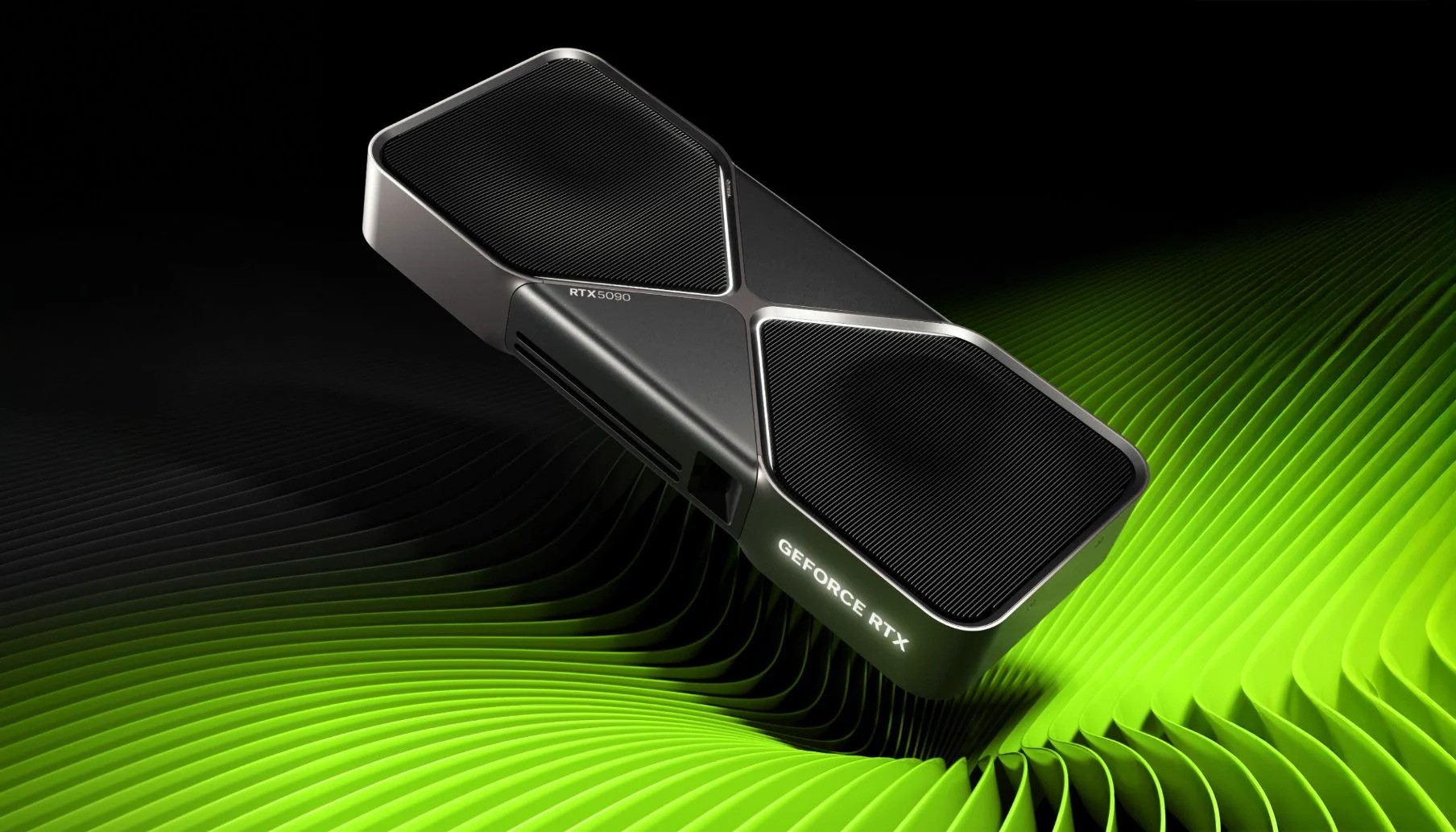
Finally, what does it all mean for us gamers? Does it mean everyone will now give up on building AI data centers, so prices of graphics cards, SSDs and RAM will return to the levels of a few years ago? Although we would certainly love that, it’s hard to imagine such a scenario. Does it mean Nvidia will abandon making graphics cards for computers and focus entirely on AI development? Although I personally wouldn’t like that to happen, realistically it has been their bigger priority for the last couple of years.
Whatever he has been doing in his private and business life over the last couple of years, it is clear that Huang, as one of the great innovators in this field, is returning to stabilize the company and calm investors. This was certainly a good occasion to remind ourselves of what links gaming and AI, and to better understand how it will likely continue to affect the entire market in the future.
Author: Miloš Hetlerović